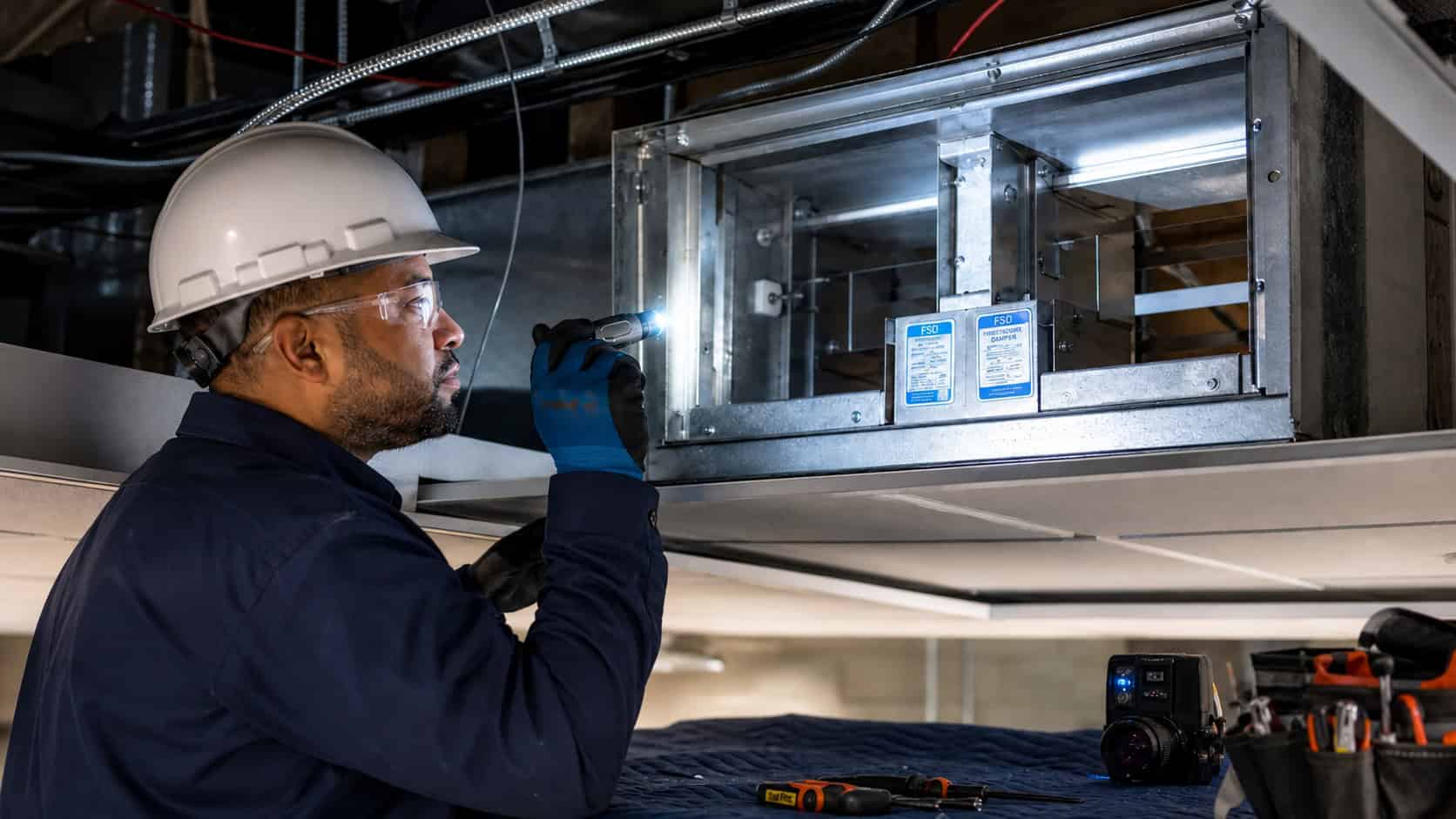
Smoke dampers play a crucial role in life safety systems across commercial, healthcare, and institutional facilities. Designed to prevent the migration of smoke through HVAC ducts during a fire event, these devices help maintain tenable conditions for occupants and support overall compartmentation strategies.
What Are Smoke Dampers?
- Specialized devices installed within ductwork and air transfer openings.
- Designed to close automatically upon detection of smoke
- Activated by duct smoke detectors or integrated with fire alarm/smoke control systems
- Intended to prevent smoke migration across smoke barriers or into exit enclosures
Where Are Smoke Dampers Required?
Building codes such as the IBC, NFPA 90A, and NFPA 105—as well as Joint Commission guidance—require smoke dampers where ducts penetrate:
- Smoke barriers
- Smoke partitions
- Certain rated assemblies depending on design
Healthcare occupancies must also comply with NFPA 101 (Life Safety Code) as adopted by CMS and enforced by accrediting organizations such as The Joint Commission.
The requirement depends on:
- Barrier type (smoke barrier vs. fire barrier)
- HVAC system design
- Presence of sprinklers
- Whether the system is fully ducted or uses air plenums
When Smoke Dampers Are Not Required
According to The Joint Commission and NFPA 90A, Smoke dampers are NOT required at penetrations of smoke barriers if:
- The HVAC system is fully ducted, and
- The building is fully sprinklered.
This exception is commonly cited in healthcare facilities and is recognized by The Joint Commission, provided documentation supports the design condition.
NOTE: This is not a blanket exemption. The life-safety drawings, mechanical design, and adopted code edition must support the exception.
Inspection and Testing Requirements (Frequently Missed)
This is where many facilities fall out of compliance.
Per NFPA 105 (2016/2019 editions commonly adopted in healthcare):
Initial Testing
- Smoke dampers must be tested 1 year after installation.
This requirement is frequently overlooked.
Ongoing Testing Intervals
After the initial 1-year test:
- Every 4 years in most occupancies
- Every 6 years in hospitals
These intervals align with CMS adoption of NFPA standards for healthcare occupancies.
Testing must verify that:
- The damper fully closes
- It is unobstructed
- It resets properly
- Documentation is maintained
Failure to perform the 1-year test or adhere to the 4- or 6-year interval is a common survey finding.
Decommissioning Smoke Dampers
If a facility qualifies under the fully sprinklered / fully ducted exception:
Smoke dampers may be legally decommissioned where code permits. This typically involves:
- Engineering confirmation of eligibility
- Disconnecting actuators (as appropriate)
- Permanently securing blades in the open position (if allowed)
- Labeling the damper as “Not Required per NFPA 90A Exception”
- Updating life-safety drawings
- Maintaining documentation for surveyors
NOTE: Decommissioning must be formally documented. Simply ignoring testing is not acceptable compliance.
Common Compliance Pitfalls
- Missing the required 1-year post-installation test
- Confusing 4-year vs. 6-year testing intervals
- Failing to update life-safety drawings after HVAC renovations
- Assuming dampers can be ignored in sprinklered buildings without confirming full ducted design
- Not documenting decommissioning decisions
Key Takeaway
Smoke dampers remain an essential part of compartmentation strategy—but they also carry inspection and testing obligations.
In healthcare facilities:
- Test 1 year after installation
- Test every 6 years thereafter
- Confirm eligibility before decommissioning
- Maintain thorough documentation
Fully sprinklered buildings with fully ducted HVAC systems may qualify for certain exceptions under NFPA 90A, but those decisions must be engineered, documented, and survey-ready.